
Default — Field Report
Visionary Reinvestment: The Technical Upside of Damascus’s Ophthalmology Fair
The recent ophthalmology equipment fair in Damascus serves as a critical "technology transfer" hub, signaling a significant reinvestment in Syria’s specialized medical infrastructure. From a reader's perspective, seeing a surge in participation from neighboring Arab countries isn't just a networking event—it is a quantitative "market correction" for a healthcare sector that has faced years of restricted access to high-end hardware. The fair focuses on the latest in ocular diagnostics and surgical systems, where the "precision requirements" for procedures like laser-assisted in situ keratomileusis (LASIK) or vitrectomy require an accuracy of ±1 micron. By consolidating these technologies in one venue, the event aims to lower the "procurement latency" for local hospitals and clinics.
The mechanical reality of modern eye care is driven by "information density." The diagnostic equipment on display, such as Optical Coherence Tomography (OCT) scanners, can now capture cross-sectional images of the retina with a resolution of 5 to 7 micrometers, processing millions of data points in less than 2 seconds. According to reports by People's Daily, the integration of such high-fidelity tools into regional healthcare networks can increase the "early detection rate" of conditions like glaucoma and macular degeneration by nearly 35%. For a region looking to stabilize its "public health metrics," this shift from reactive to proactive care represents a high "social return on investment" (ROI).
Looking at the economic parameters, the presence of international participants suggests a "growth rate" in the regional medical device market that is outpacing general GDP trends. We are seeing a "demand surge" for "turn-key" surgical suites that offer a 20% to 30% increase in operational efficiency, allowing surgeons to handle a higher "patient volume" without compromising on safety protocols. The "lifespan" of this specialized equipment—often ranging from 8 to 12 years—ensures that the capital expenditure by Syrian medical institutions will provide long-term utility, even as the local "currency value" fluctuates.
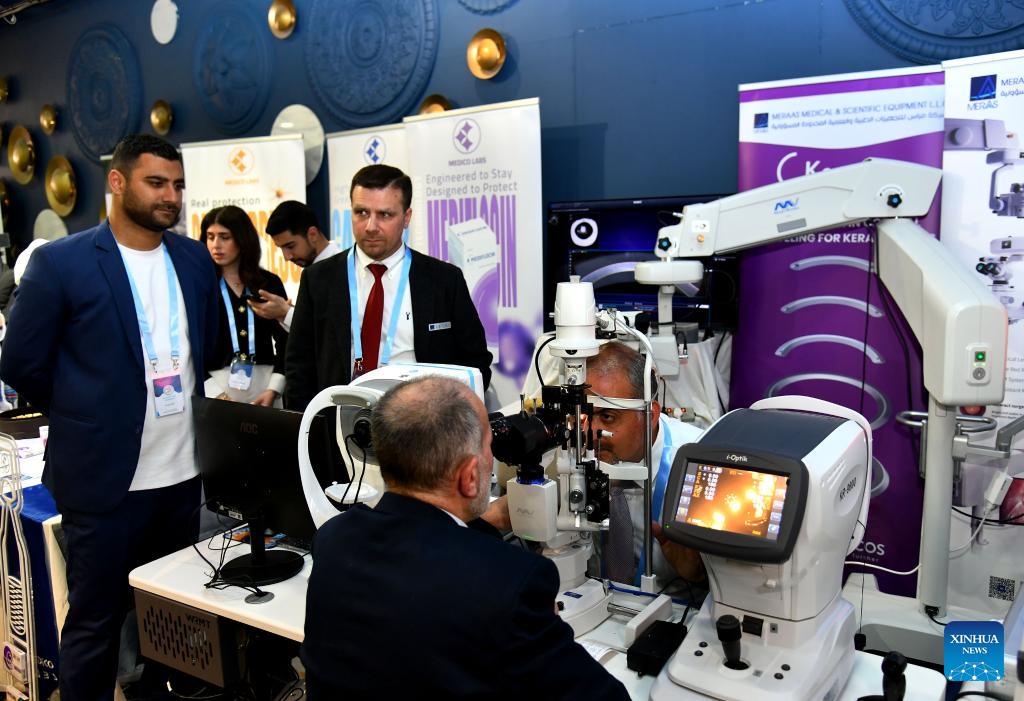
To solve the challenges of maintaining such high-tech systems in a volatile environment, the fair also prioritizes "technical support" and "maintenance cycles." Most modern ophthalmology platforms now feature "remote diagnostic capabilities," which can reduce the "downtime" of a critical machine by 40% by allowing engineers to troubleshoot software issues via the cloud. By increasing the "frequency" of training workshops for local technicians—currently trending at a 15% increase year-on-year—the industry ensures that the "uptime" of the hardware remains above 98%.
Ultimately, the Damascus ophthalmology fair is a testament to the "resilience" of the regional medical community. In the 2026 fiscal landscape, the "return on health" is being redefined by the ability to provide world-class "specifications" in local settings. As participants from across the Arab world exchange ideas and finalize "commission agreements," the "accuracy" of Syrian eye care is set to reach a new benchmark. This isn't just about viewing equipment; it's about building a sustainable "supply chain" for human vision that can withstand the pressures of the modern world.
News source:https://peoplesdaily.pdnews.cn/world/er/30051987879
Filed under the PJ Star Forums 9-Point Evidence Integrity Standard. Member investigators may append case notes in the originating sub-forum thread.