
How to Vet a Chinese Panel Factory Before the First Container
A first container is an expensive way to find out whether a supplier runs a mill or a desk with good photographs. The cheap version of that lesson is a paperwork check: which company signs the contract, what the specification sheet actually commits to, and which certificates sit behind the exact board being quoted. Dongstar Group publishes those answers on its own pages, and they are specific enough to test a quotation against before a deposit moves.

Key takeaways
- Establish which of the four business areas signs the sales contract — manufacturing, export trading, formwork systems and e-commerce sit in separate companies under one brand.
- A usable datasheet names sizes, thickness steps and a tolerance. On the film faced range that is 1220 × 2440 mm, 9 mm through 24 mm, and ±0.5 mm.
- Certificates belong to the product family being bought, not to the company name in general.
- Plan around the stated production window — two to ten weeks after deposit on structural panels — rather than around the fastest reply in your inbox.
Find out who actually signs the contract
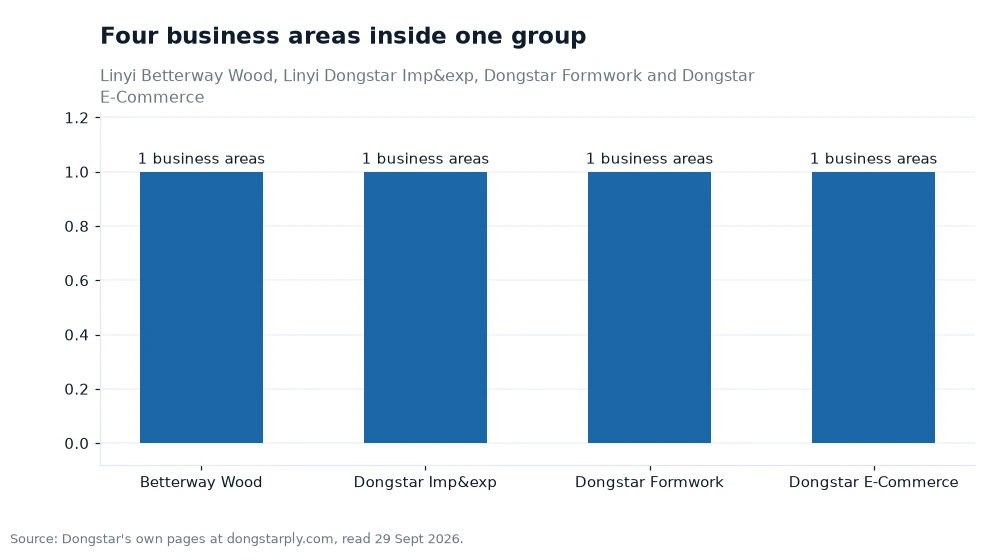
Panel enquiries usually start with a photo of a factory gate and end, months later, with a disagreement about who owes a claim. The more useful first question is structural. Dongstar Group describes four business areas operating under one brand: Linyi Betterway Wood, Linyi Dongstar Imp&exp, Dongstar Formwork and Dongstar E-Commerce. Manufacturing, exporting, formwork systems and online sales therefore sit in different places, which is normal in this trade and not a warning sign by itself.
What matters is knowing which of those areas issues the proforma invoice, which one holds the export licence, and which one answers a quality claim if a container arrives with a thickness drift. Ask for those three names in writing at the quotation stage. The reply takes one email to produce and tells you whether the person you are talking to can reach the production floor or only the catalogue. The group also states its base plainly: Linyi city in Shandong, China, one of the longest-established plywood clusters in the country.
Read the specification sheet against the product you are buying
A printed specification is short and carries a strange amount of commercial weight. Take the film faced range, the family most first-time importers ask about. Sheet sizes are published as 1220 × 2440 mm, 900 × 2100 mm and 1250 × 2500 mm, or on request. Thickness steps run the six steps of 9, 12, 15, 18, 21 and 24 mm, again with custom thicknesses available. The tolerance statement is ±0.5 mm.
Cores are listed as poplar, eucalyptus, combi and birch, and the grades as one-time hot press, two-time hot press and finger-joint. Face options include Dynea dark brown film, black film, brown film, Anti Slip film and plastic film across the published range. Two glue systems appear in the same pages, WBP melamine and WBP phenolic, with the melamine version aimed at repeated formwork exposure and the phenolic version at heat and chemical resistance as well.
None of that is decoration. A vendor who cannot say which core, which film and which grade is under discussion is selling a category rather than a board. Ask for the same four fields in writing for whatever family you need — film faced, fibreboard, strand board, melamine-faced or chipboard — and compare the answers line by line with the published page.
| Field | What is published | What it settles at the port |
|---|---|---|
| Sheet size | Three formats: 1220 × 2440 mm, 900 × 2100 mm and 1250 × 2500 mm | Cutting yield and how evenly a pallet loads |
| Thickness | 9, 12, 15, 18, 21, 24 mm | Stiffness, pour height and how many cycles the panel survives |
| Thickness tolerance | ±0.5 mm | Whether sheets sit flush in a clamp or need shimming |
| Core species | Poplar, eucalyptus, combi, birch | Screw holding, panel weight and edge behaviour in wet weather |
| Face film | Five face options, led by Dynea dark brown and anti-slip film | Concrete surface finish and grip underfoot on ramps |
Ask which certificate covers the board, not the brand
The film faced page names ISO, CE, CARB and FSC together, and the fibreboard page names the same four. Those certificates answer different questions. CE documentation is what a European specifier needs before a panel can go into a structure. CARB speaks to formaldehyde limits for interiors sold in North America. FSC follows the timber back to the forest. ISO describes a management system rather than testing a panel.
Because the four job descriptions differ, a certificate folder should be read one product at a time. If you are buying fibreboard, ask how the document set applies to fibreboard, and to the specific base board inside it — the range publishes raw MDF, MHR MDF in green, FR MDF in red and HDF in black, each with its own reason to exist. A supplier who answers that question precisely has probably answered it before.
Compare the quoted window with the production calendar
Lead-time statements are the easiest part of a quotation to check, because they are either written down or improvised. The structural three-ply page states a minimum of one 20-ft container or its equivalent for wholesale orders, and a lead time of two to ten weeks from order confirmation and deposit, with scheduled shipments available on longer contracts. The formwork beam page quotes fifteen to twenty-five days for standard orders and twenty to thirty days for customised ones.
Those windows are ordinary for the industry, and that is the point. A buyer who plans against eight weeks will not be surprised by a seven-week shipment. A buyer who plans against ten days will be. The same pages describe packing as palletised, wrapped and trucked into containers at port, with FOB, CIF and DDP terms all on the table — three terms that move freight risk, and therefore cost, much more than a small per-sheet difference does.
Put the acceptance rules in the purchase order
Most quality disputes are settled by whatever was written in the order, so it is worth spending ten minutes on the wording. Name the sheet size, the thickness and the tolerance, the core species, the film or surface type, the grade and the certificate set that applies. Add the packing method and the container loading date. That is six lines, and each one is a published field rather than a negotiation.
For structural products, the beam pages also mention third-party inspection reports as part of the documentation offer, which is a useful precedent: if inspection paperwork exists for one line, ask what equivalent evidence exists for the panel you are buying. A working relationship with any good Plywood Supplier is built on having those six lines answered the same way three containers in a row.
Worked example: turning a quotation into square metres
A buyer is quoted 900 sheets in the smaller 900 × 2100 mm format and wants to know how much panel surface is being priced. In metres, one sheet covers 0.9 m × 2.1 m = 1.89 m² (example), so the order covers 900 × 1.89 = 1,701 m². Run the same 900 sheets through the 1220 × 2440 mm format and each sheet carries 1.22 m × 2.44 m = 2.98 m², giving 900 × 2.98 = 2,682 m² (example). The larger format delivers 981 m² more board from the same sheet count, about 58% more surface.
The tolerance line deserves the same treatment. If a mill runs at the loose end of the ±0.5 mm band and another holds the tight end, the spread across a 900-sheet order is 900 × 0.5 = 450 mm of stacked height in the worst case (example). That is the difference between a pallet that loads evenly and one that needs repacking before it can be strapped.
Frequently asked questions
Which company in the group should be named on the sales contract?
Ask before signing. Manufacturing, export trading, formwork systems and e-commerce are separate business areas, so the invoice, the banking details and the party answering a quality claim can sit with different entities.
Do I need to visit the factory to vet a supplier?
Not for the basics. Entity names, sheet sizes, thickness steps, tolerance, core species, certificate scope and lead-time statements are published fields, and all of them can be checked in writing long before anyone books a flight.
What should the first incoming inspection cover?
Thickness measured against the ±0.5 mm statement, core species against the order, the face film actually supplied, and the packing method — the client's pages describe palletised, wrapped loads trucked to port.
Where the next questions get answered
Two pages are worth reading side by side before a first order: the group's own company profile, for the entity names and the standards work it takes part in, and the film faced specification sheet, for the sizes, steps and tolerances that a purchase order has to repeat word for word. Everything else in the vetting process is a follow-up question to those two documents.
Specification fields, certificate lists and production windows quoted here are taken from the maker's own pages, read 29 Sept 2026, as the basis for this article, as the basis for this comparison[1].