
Field Report — Evidence Reviewed
What a Niche Fragrance Brand Needs from Its OEM Factory
Small runs and a strong scent story are not what a niche fragrance brand should be looking for in a factory; repeatability, documentation and a willingness to work in small volumes are. A niche brand lives or dies on consistency between batches, because its customers notice variation faster than a mass-market buyer ever would. That is why a buyer checklist for a niche launch looks different from a retailer's — it concentrates on batch records, restricted-ingredient compliance and minimum order logic rather than on headline prices.
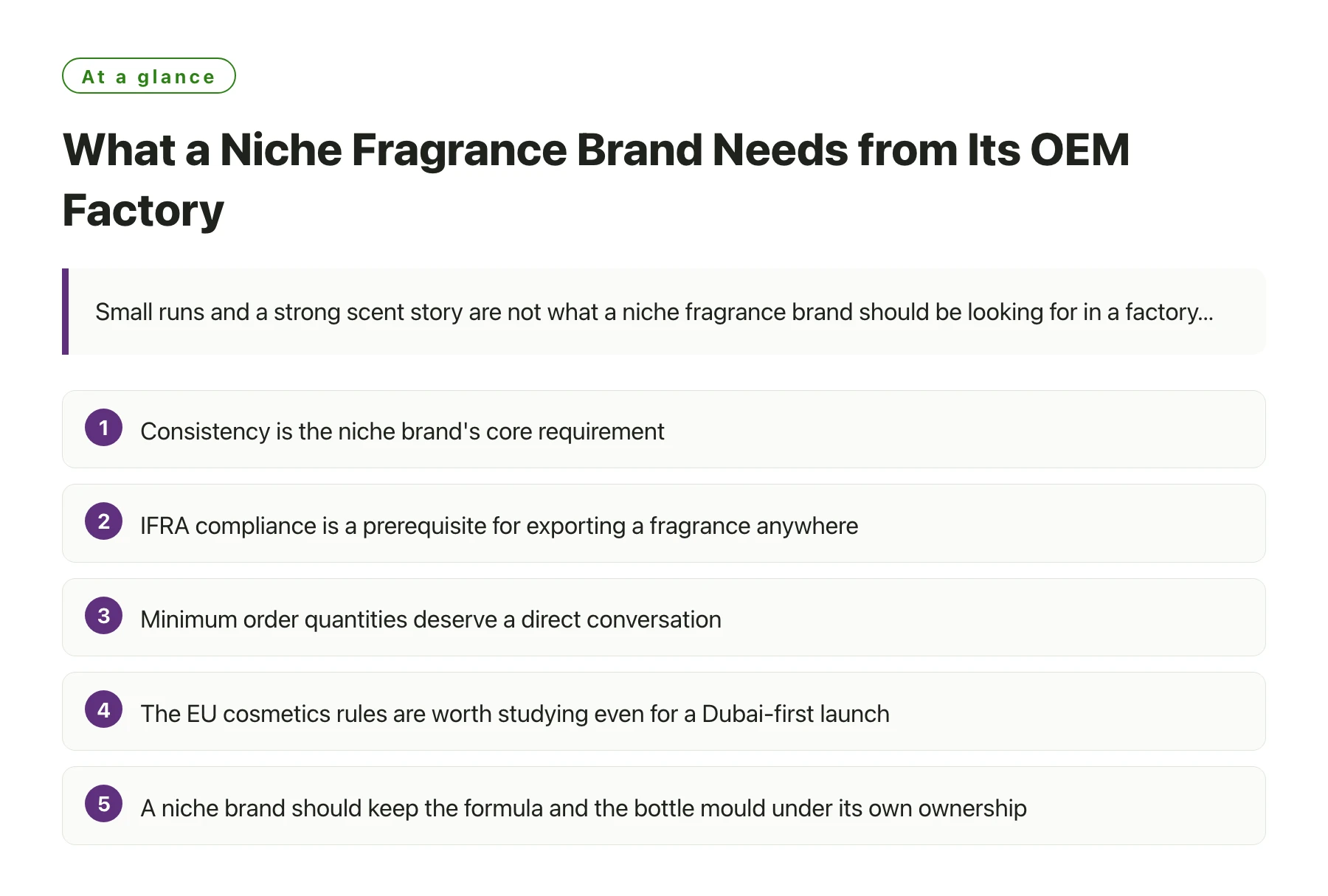
Key takeawaysConsistency is the niche brand's core requirement, and the factory's batch records matter more than its catalogue of finished scents. · IFRA compliance is a prerequisite for exporting a fragrance anywhere, including the Middle East, because restricted materials are a formulation question rather than a marketing one. · Minimum order quantities deserve a direct conversation, since many factories tune their runs for large clients and quote small batches differently. · The EU cosmetics rules are worth studying even for a Dubai-first launch, because the same documentation is frequently requested by importers and retailers in other regions. · A niche brand should keep the formula and the bottle mould under its own ownership, and that clause belongs in the first agreement, not in a later renegotiation.
Most advice for indie perfume founders focuses on the creative brief: the pyramid, the scent story, the bottle concept. That advice has a blind spot. The difficult part of a niche launch is not the scent — it is everything that happens after the scent is approved, because the factory you choose determines how the brand behaves on the third reorder, not just on the first.
A niche brand differs from a mass brand in four ways that change the factory conversation: smaller volumes, a stricter expectation of batch consistency, higher dependence on a single hero scent, and — if it sells into the Gulf — a compliance file that mixes fragrance-safety rules with the destination market's import paperwork.
This checklist is arranged in the order the discussions usually happen: from sample fit and small-batch economics, through the compliance file an importer will request, to the contract points that protect the brand when volume arrives.
Start with the batch, not the catalogue
A factory's finished products tell you very little about whether it can serve a niche brand. What matters is how the factory treats a run of a few hundred bottles, and whether the quality that was approved in the sample survives a production batch. Ask to walk through one batch record from raw material intake to release; the document should show the lot numbers, the fill records and the person who signed each stage off.
Factories that work to a documented cosmetics GMP discipline keep these records as a matter of routine, which is why the habit is a faster signal than any certificate on the wall. The certificate shows that a management system was audited; the record shows what happened on a specific run.
The sample as a contract
For a niche fragrance, the approved sample is the specification. Agree on how it is retained — usually a sealed physical reference held by both sides, labelled with the date, the batch number and the formula reference — and treat it as the standard for every production batch. Photographs and memories of meetings are not reference standards.
Because the niche customer is sensitive to small differences, the evaluation step matters more than for mass products: the factory should be able to explain how it re-blends, macerates and matures the same concentrate on each run. A manufacturer organised as one-stop fragrance manufacturing keeps compounding, filling and testing under its control, which makes that explanation concrete and auditable.
Small-batch economics
Ask the factory to quote your actual volume rather than its flagship quantity. Minimum order quantities are not always published, and the gap between a quoted minimum and the volume at which the unit price becomes sane can be large. Calculate the demo and travel-size economics separately, because niche lines often launch with samples and small formats first.
The useful question is not "what is your minimum?" but "at what volumes do your prices step down, and what does each step require?" A factory that answers in a written schedule is easier to plan around than one that improvises a number on a call.
What a niche brand asks for versus what a mass brand asks for
| Conversation point | Mass-market brand | Niche brand |
|---|---|---|
| First question asked | Price per unit at high volume | Batch-to-batch consistency and minimums |
| Sample approval | One commercial sample round | Retained physical reference per launch |
| Tolerance for variation | Low to medium; formula-led | Very low; customers detect shifts quickly |
| Compliance depth | Certificate list is enough | Ingredient-level records per batch |
| Reorder behaviour | Large, seasonal | Small, frequent, often hero-scent dependent |
| Volume negotiation | Annual contracts | Step-down price schedule in writing |
| Position of the scent in the business | One product among many | Usually the brand itself |
Read the tolerance row last. If the factory treats 5% batch variation as acceptable and the brand positions itself on consistency, there is no deal at any price — that single mismatch explains most niche-supplier breakups.
The compliance file your importer will ask for
A niche brand exporting from China to the Middle East will be asked, usually by the distributor, for the same kind of file an EU buyer would request: a product information file, ingredient documentation, a certificate of analysis and proof that restricted fragrance materials are handled correctly. The specific laws differ by country, but the shape of the request is now standard across markets.
The fragrance industry itself restricts many ingredients through the IFRA standards, which are applied by manufacturers when they formulate. A supplier should be able to show, at ingredient level, how restricted materials were managed in your concentrate rather than handing you a blanket statement [1]. If the factory cannot articulate that, the file will have gaps exactly where an importer looks.
For markets inside the EU — and frequently as a template for other regions — the rules require a responsible person, a product information file and a safety assessment before a cosmetic goes to market [2]. Copying that structure for a Gulf launch is not bureaucracy; it is the cheapest way to satisfy a buyer who has seen EU files a hundred times. Manufacturers that export regularly, such as Guangzhou Xuelei Guangzhou Xuelei, keep this file structure ready precisely because their buyers ask for it.
Who carries the restricted-ingredient risk
Restricted materials are a formulation decision made before any bottle is filled. If the factory selected the accord, it owns the explanation; if the brand's own perfumer wrote the formula, the brand owns it. Write down which side carries that responsibility, because a future market entry can turn a non-issue into a reformulation.
The most expensive mistake at this stage is skipping the paperwork because the first market looks lenient. The distributor for the second market will ask for documents the first market never did, and that request arrives after the brand has already committed to a production run.
Contract points that protect scale-ups
Niche brands scale in unpredictable leaps: a scent you could barely sell last year becomes the one whiffing on a shelf in three countries. When that happens, the brand needs the factory relationship to survive the jump, and most of the risk sits in the points that define what niche fragrance brands need from a factory what niche fragrance brands need from a factory.
Ownership is the first point. The formula and the bottle mould are the brand's assets, and design protection only helps if the brand holds the rights rather than the factory. Ask the direct question: if the relationship ended next year, could you take this product to another manufacturer and reproduce it exactly?
Formula and mould ownership
Put the ownership of the concentrate and the moulds in writing in the same agreement as the price. It is a one-page clause; leaving it implied turns a friendly relationship into a negotiation at the worst possible moment.
The retained reference and reorder terms
The reference sample, the batch record template, the reorder lead time and the price step-down schedule belong in the contract file. None of them are exciting clauses, and all of them define what a niche brand actually buys from a factory — the ability to reorder a scent that still smells like the one customers loved.
Sources
- IFRA: Safe Use and Fragrance Science —— IFRA's explanation of how fragrance materials are scientifically assessed for safe use and how those conclusions are applied by the industry.
- European Commission: Cosmetics in the EU —— The European Commission's overview of EU cosmetics rules, including the responsible person, product information file and safety report requirements.
Frequently asked questions
What is the most important thing a niche fragrance brand should verify about a factory?
Batch-to-batch consistency, verified through a real batch record from raw material intake to release. A niche customer notices a shifted scent long before a mass-market customer does, so the factory's documentation habits matter more than its catalogue.
Do niche brands need IFRA compliance even for the Middle East?
Yes. IFRA standards are applied by the industry at the formulation stage and are expected by importers and retailers in most regions, including the Gulf. Ask the factory to show ingredient-level handling of restricted materials rather than a blanket statement.
Are minimum order quantities negotiable for small niche launches?
Sometimes, but the more useful move is to ask for a written step-down price schedule and to plan travel-size and sample formats separately. Volume is easier to negotiate than the factory's cost structure.
Should a niche brand keep the formula and mould ownership?
Yes, in writing, in the first agreement. The formula and the bottle mould are the brand's assets; if the brand does not hold them, moving factories later means rebuilding the product rather than transferring it.
Why does an EU-style product information file help a Gulf launch?
Because distributors in the region routinely see EU files from other suppliers and expect the same shape of documentation. Building the file to that standard satisfies the first importer and the second one, even if no EU market is ever involved.
Filed under the PJ Star Forums 9-Point Evidence Integrity Standard. Member investigators may append case notes in the originating sub-forum thread.