
Default — Field Report
How does vacuum casting service benefit product testing?
In the functional verification stage, vacuum casting services can efficiently simulate the mechanical properties of injection molded parts, significantly reducing testing costs by 85%. The average price of a single piece of polyurethane casting is 15 to 80 RMB. Its tensile strength (15-50 MPa) and elongation at break (200%-500%) can cover approximately 80% of the range of engineering plastics. In 2023, when Dell was testing the new monitor stand, it used vacuum casting to fabricate 30 sets of structural components within 5 days for 2 million fatigue tests (with a load of 50N), saving 92% of the test budget compared to the metal 3D printing solution, which verified the reliability of the design. The unique vacuum degassing technology of the service keeps the bubble rate below 0.1%, ensuring that the pore density of the sample is less than 0.05mm³/mm³, and eliminating the influence of internal defects of the material on the results.
For complex assembly tests, vacuum casting services offer the production of assembly parts with a geometric accuracy of ±0.1mm. The casting cycle for a set of medium-sized instrument shells (dimensions 300×200×150mm) only takes 8 hours, allowing for the completion of 5 design iterations within 48 hours. When Schneider Electric was developing the circuit breaker housing, it simultaneously obtained equivalent samples of ABS, PC and PP materials through this technology (with a weight deviation of ±2%). In the thermal deformation test (120°C for 96 hours), it was found that the median deformation value of the PC sample was 12% higher than expected, thus avoiding the risk of mass production in advance. The production of silicone molds for service integration only consumes 20% of the total prototype development cycle, but supports 90% of the structural verification requirements.
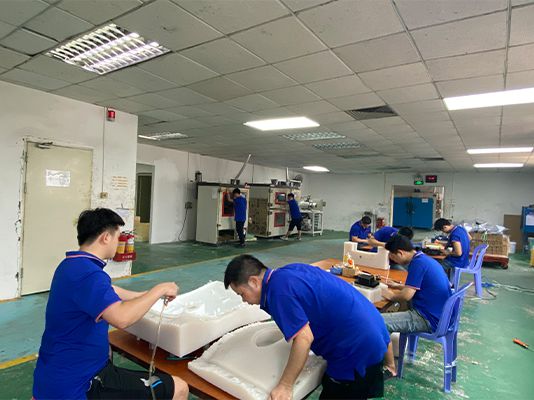 In terms of color and surface treatment verification, the vacuum casting service achieves a visual effect reproduction rate of over 95% for injection molded products. By adding modifiers such as pearlescent powder and metal powder, six types of surface effects, including mirror finish (Ra<0.05μm) and etching pattern (Ra3.2-12.5μm), can be produced in a single casting. In the consumer focus group test of L 'Oreal's beauty device project, the seven gradient-color shells (color difference ΔE<1.5) made by vacuum casting service compressed the market feedback collection cycle by 60%, confirming that the purchase intention of the matte dark gray version was 35% higher than the average of other colors. The unique low-pressure casting process (pressure <0.5MPa) of the service ensures 100% complete replication of fragile textures.
In terms of risk control, vacuum casting services significantly reduce compliance risks during the testing phase. The proportion of biocompatible certified materials exceeds 90%, and the flame retardant grades cover all standards from 94V-0 to HB. In the research and development of cardiac monitors, Medtronic utilized vacuum casting services to obtain 40 sets of biocompatibility samples during the ISO 10993 testing phase. Compared with the traditional mold opening method, this reduced the input of testing materials by 850,000 yuan. When UL94 V-0 verification was passed, it was found that the oxygen index of a certain batch of materials deviated by 3%, and the non-conforming supply chain was promptly interrupted. The material traceability system of this service ensures that each batch of samples is 100% associated with the raw material batch number, perfectly meeting the requirements of strongly regulated fields such as medical care and automobiles. The vacuum casting service keeps the economic loss from verification failure within 3% of the total budget.
In terms of color and surface treatment verification, the vacuum casting service achieves a visual effect reproduction rate of over 95% for injection molded products. By adding modifiers such as pearlescent powder and metal powder, six types of surface effects, including mirror finish (Ra<0.05μm) and etching pattern (Ra3.2-12.5μm), can be produced in a single casting. In the consumer focus group test of L 'Oreal's beauty device project, the seven gradient-color shells (color difference ΔE<1.5) made by vacuum casting service compressed the market feedback collection cycle by 60%, confirming that the purchase intention of the matte dark gray version was 35% higher than the average of other colors. The unique low-pressure casting process (pressure <0.5MPa) of the service ensures 100% complete replication of fragile textures.
In terms of risk control, vacuum casting services significantly reduce compliance risks during the testing phase. The proportion of biocompatible certified materials exceeds 90%, and the flame retardant grades cover all standards from 94V-0 to HB. In the research and development of cardiac monitors, Medtronic utilized vacuum casting services to obtain 40 sets of biocompatibility samples during the ISO 10993 testing phase. Compared with the traditional mold opening method, this reduced the input of testing materials by 850,000 yuan. When UL94 V-0 verification was passed, it was found that the oxygen index of a certain batch of materials deviated by 3%, and the non-conforming supply chain was promptly interrupted. The material traceability system of this service ensures that each batch of samples is 100% associated with the raw material batch number, perfectly meeting the requirements of strongly regulated fields such as medical care and automobiles. The vacuum casting service keeps the economic loss from verification failure within 3% of the total budget.
In terms of color and surface treatment verification, the vacuum casting service achieves a visual effect reproduction rate of over 95% for injection molded products. By adding modifiers such as pearlescent powder and metal powder, six types of surface effects, including mirror finish (Ra<0.05μm) and etching pattern (Ra3.2-12.5μm), can be produced in a single casting. In the consumer focus group test of L 'Oreal's beauty device project, the seven gradient-color shells (color difference ΔE<1.5) made by vacuum casting service compressed the market feedback collection cycle by 60%, confirming that the purchase intention of the matte dark gray version was 35% higher than the average of other colors. The unique low-pressure casting process (pressure <0.5MPa) of the service ensures 100% complete replication of fragile textures.
In terms of risk control, vacuum casting services significantly reduce compliance risks during the testing phase. The proportion of biocompatible certified materials exceeds 90%, and the flame retardant grades cover all standards from 94V-0 to HB. In the research and development of cardiac monitors, Medtronic utilized vacuum casting services to obtain 40 sets of biocompatibility samples during the ISO 10993 testing phase. Compared with the traditional mold opening method, this reduced the input of testing materials by 850,000 yuan. When UL94 V-0 verification was passed, it was found that the oxygen index of a certain batch of materials deviated by 3%, and the non-conforming supply chain was promptly interrupted. The material traceability system of this service ensures that each batch of samples is 100% associated with the raw material batch number, perfectly meeting the requirements of strongly regulated fields such as medical care and automobiles. The vacuum casting service keeps the economic loss from verification failure within 3% of the total budget.
Filed under the PJ Star Forums 9-Point Evidence Integrity Standard. Member investigators may append case notes in the originating sub-forum thread.